
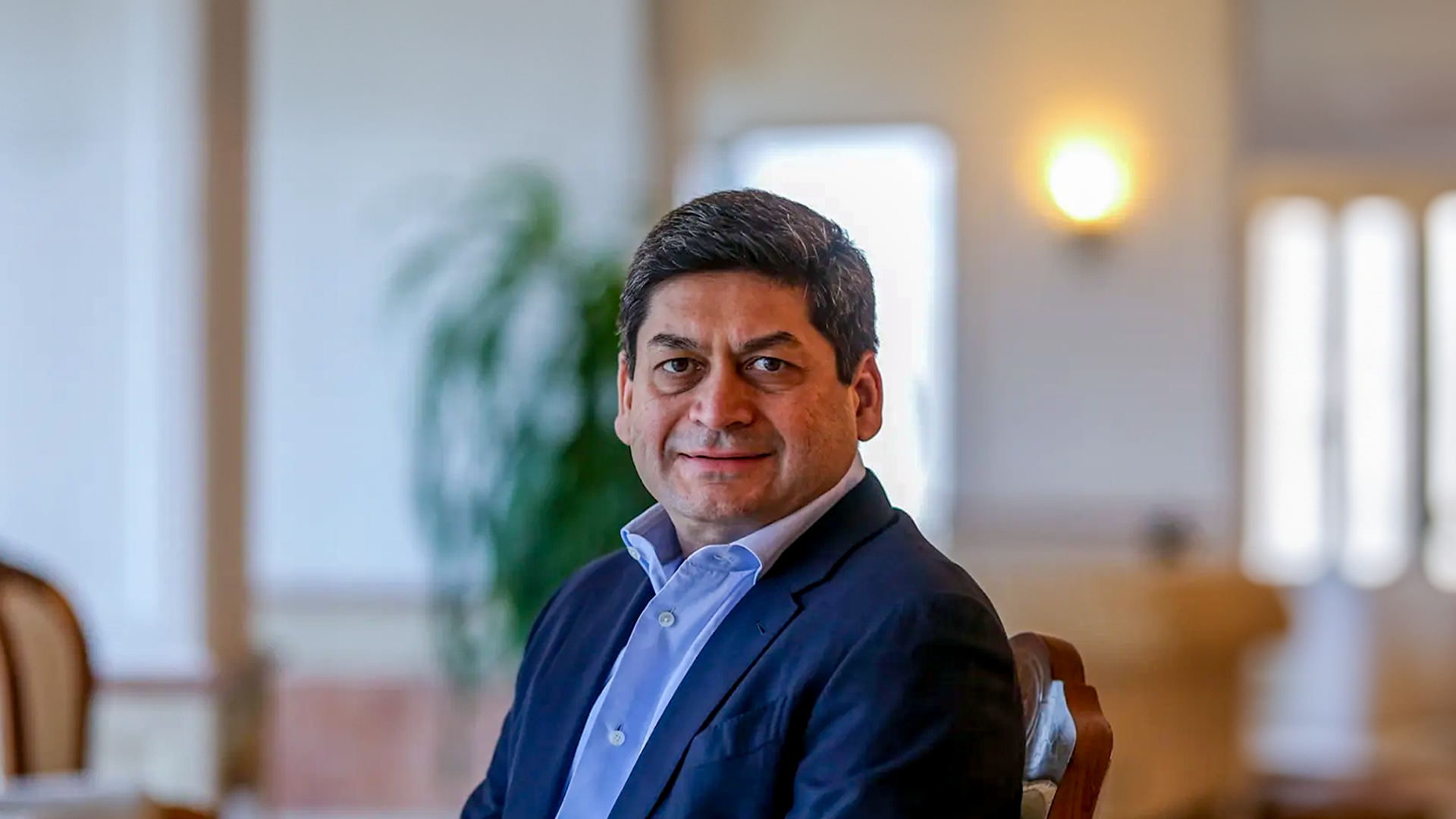
For this edition of the India Business Briefing Q&A, I (Veena Venugopal) spoke with Prashant Ruia, director of Essar Capital. Until around the 2010s, the 56-year-old Essar Group was one of India’s largest conglomerates, with significant stakes in everything from ports to steel to telecoms. But the heavy investments in capital-intensive sectors, and some unfavourable regulatory changes in the early part of the last decade, took a toll on the company’s balance sheets.
The last few years have been one of consolidation and renewal for the group. In order to deleverage, it sold its oil division and business process outsourcing company, while its flagship steel manufacturing unit — Essar Steel — entered into insolvency proceedings and was eventually acquired by ArcelorMittal. Ruia and I talked about the future outlook for the group and the lessons it has learned from its past, and why, despite its net zero ambitions, it isn’t shutting the door on fossil fuels.
Note: This interview has been edited for length and clarity
Let’s begin by talking about the last few years. What was your vision during the process of deleveraging the group, and what were the strategies and focus areas that emerged from there?
Principally, the Essar Group has focused on four sectors in the last two decades. These are energy, infrastructure, metals and mining, and technology. In the deleveraging process we went through, we monetised a couple of our companies. We have spent the last four to five years growing our interests in these sectors. What has changed is that within these sectors we are now investing in some of the newer technologies, especially around energy transitions and decarbonisation. But, overall, at a fundamental level, not much has changed for the group.
What are some of the key projects, in India and globally, that you are counting on to take the group into the next phase of growth?
Our structure is that we have Essar Global as a holding company, from which we make our portfolio investments. We have nine or 10 companies that are growing in the portfolio. Our investments are diversified. We have a transport fuel investment in the UK, and a major iron ore project in Minnesota in the US. Mobility is another sector in which we are heavily invested. This includes LNG, but is mainly electric. We are building a full network of heavy-duty trucks in India.
Then, of course, we’ve got our traditional businesses — ports, power etc — which are also growing. As India continues to grow at 6-7 per cent, there is a tremendous demand for all of these. The other is coalbed methane, where we are one of India’s largest producers. We have an IT business, Black Box, which is building network and data centres globally, mainly in the US. So, it’s a diversified portfolio, and it’s a global portfolio, and we see tremendous growth in it.
The group’s past expansion was aggressive and, if I may say so, costly. What lessons do you think can be drawn about leverage, control and capital allocation from that experience? How do you ensure discipline in this next growth cycle?
Good question. I look at it quite differently, we have also had a little bit of time to reflect on this. Firstly, I don’t think our investment decisions in the past were bad, they were good decisions. We built world-class assets and we were not overleveraged by most standards. What really happened was that we were caught out by some regulatory decisions and court orders. This affected the entire industry, not just us.
But despite that, because the quality of assets and our people were really high, when we decided to monetise some of these assets, we got good value for it. As you know, we have repaid more than $20bn of debt. Anyway, all of this happened more than five years ago. It is firmly in the past.
Where does your debt burden stand currently?
From a group perspective, of course, it’s never going to be zero debt. But we have paid off more than 95 per cent of our past debts.
My question was not a critique of your past decisions, instead I wanted to understand what lessons you took from it and how it is influencing your current decisions and future plans.
We think we made the right decisions, so there is no real change. In terms of lessons, the sectors we focus on haven’t changed. However, we are now focusing more on newer technologies in those sectors. I don’t think we have really changed our investment profile significantly.
Our risk management has gone up, we do a lot of deep analysis before we make investment decisions. But principally, the group’s core strength is in building world-class assets, operating world-class assets, and scaling up these assets to take care of the market. Those are the strengths which we are trying to play on.
One of your big investments is the Stanlow refinery in the UK. You have stated your ambition of making it Europe’s first hydrogen ready plant. What is the progress you are seeing there?
Our principal focus is to create an energy transition hub in the north-west at Stanlow. We currently have a refinery there, from where we supply road transport fuels to the UK. We also supply aviation fuel to some 10 airports. We are now building a hydrogen plant, as well as a power plant that is fired off the hydrogen.
These are part of our net zero ambitions in the UK. The total investment is about £1.5bn and once this is all built, we will be one of the most decarbonised refineries, globally. The government supports our initiatives and it is a very progressive programme for achieving net zero.
Essar remains one of a handful of Indian groups with a truly international footprint. So how do you now think about geography? Is your plan to shift more to India or expand more outside? Other large Indian groups are also making significant investments in steel units in Europe and Africa, for example.
Broadly, as a group, our investments are 50 per cent in the domestic market and the rest is abroad. Our headquarters remain in India, but we continue to invest in different geographies. We’ve been doing this since 2010, so it’s not new to us. We are continuing to look at the US as a significant investment destination. We have invested close to $2bn in the US.
Other than this, we’ve always kept an eye on the Middle East. There is a lot happening there, we are developing a couple of projects but they are at an early stage.
You have largely run capital-intensive traditional businesses. How do you make a conglomerate like yours agile, and bring in digital capability, and other technology efficiencies into the heart of that model?
Our technology businesses are built on the latest infrastructure. For the traditional business, our goal is to utilise the technology that is available now to help digitalise the business for better efficiency. It is a process, there is no single answer to it.
In the manufacturing plants, we are introducing cutting-edge automations, AI tools etc. And in investing in energy efficiency and decarbonisation, we are also upgrading our energy technology. These are things which have not been done so much in the past.
On renewables, is there any change in how you are looking at the business in a world, which post-Trump, seems to be going back to fossil fuel. Has that change in narrative affected your plans?
Look, I think this is the pendulum sort of swinging too far the other way. It’s going from one end to the other end and now it’s gone back. I think the answer is somewhere in the middle. I don’t believe that fossil fuels are in the past, and that everything is going to go green.
If anything, the current situation in the Middle East has shown us the critical role oil and gas continues to play in the world. This will only lead to more countries, globally, looking for energy security. In our group too, we have not shut the door on fossil fuel investments, the current situation makes the case for our business stronger.
Source: Financial Times














 User
User