
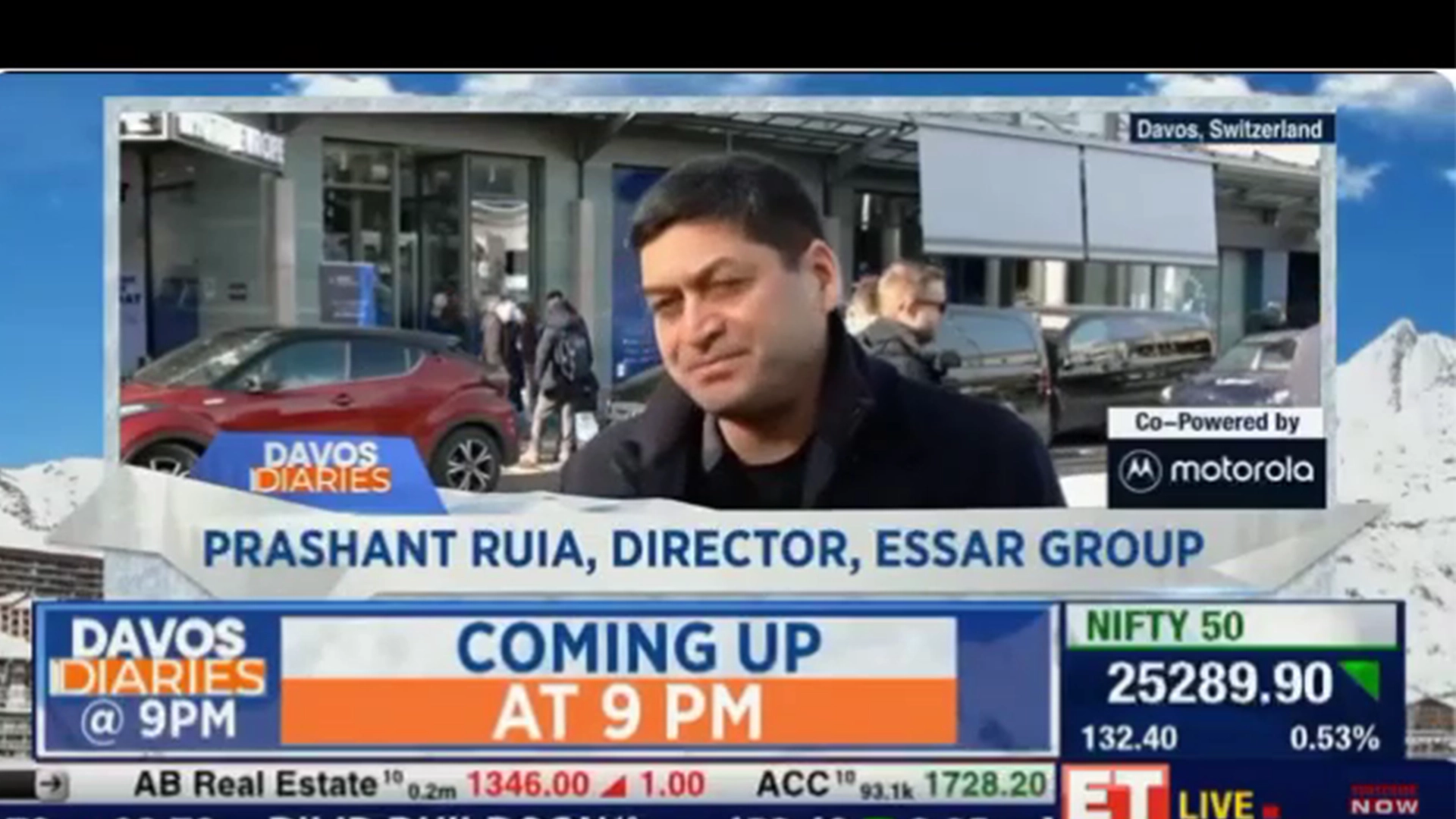
Interview Transcript
Welcome to Davos Diaries here on ETNOW and we’re here at the World Economic Forum in Davos in Switzerland.
Let’s talk energy transition and more importantly, how Indian CEOs are actually sort of maneuvering their businesses and turning agile in this very fragmented world, in this world full of flux. And who better than Prashant Ruia, Group CEO at Essar to talk about all of that and more. Prashant, great to have you on ETNOW. Thank you for your time today.
The hot topic of discussion, Donald Trump and the world that we’re in right now. Tell me, how do businesses such as yours read into this very flux or state of flux that the world is in right now?
Well, first of all, thank you for having me. I mean, that’s a tough one to start with. I mean, look, I think the flux and basically the old world order is, I think, getting changed and getting and is going to go through significant change in the next few years, certainly for the next three years. And that’s creating, obviously, a significant amount of uncertainty and risk within the businesses. For us at Essar, obviously, in the businesses which we are, it hasn’t really affected us that seriously. We are big investors in the US. And so if you’re in the US, then you’re a little bit insulated, relatively insulated. And then for businesses which are in India, we are really not big exporters to the US. So it’s not that it’s not really affected us that much. But obviously, business sentiment, there’s, you know, there is there’s a lot of talk around, you know, which way the which way is the world going. And I think the biggest issue around at this point of time, and in this Davos is around really Europe and the relationship between Europe and the US and NATO. And I think that’s that seems to be the single most defining feature. I would say India is not really on the map right now. Yeah.
When these when these two are really and of course, Greenland. This is Venezuela. This is Greenland. The world map, it seems is going to change itself as we know it.
But tell me, you did talk about your businesses in the US. In the last six months, how have things changed? How have you maneuvered through it all?
Well, we have, well, in all this uncertainty, let me also say, there’s a lot of opportunity. And the opportunity is because technological change which is taking place right now is allowing a significant investment or not allowing requiring significant investment in traditional industries. Yeah. So industries like power, industries like infrastructure, industries like, you know things, even oil and gas, were sectors which were for the last 10 years, effectively, most international companies were not investing in or, or most banks were not, you know, what we’re not financing. And so that has changed. And there is a huge demand. There’s a huge opportunity, therefore, for people to invest. And we are actually maneuvering ourselves to be in a good position to participate in that growth. And so we are looking at the opportunity in the middle of all this. Of course, there are challenges, but there’ll always be challenges.
Is it easy to spot of opportunities?
I would say, I would not say easy, but I think we have, I’m pretty pleased that we’ve come across, we have come up with a good set of investment ideas, which are meeting this demand, and which are good, which are, which will be good for the future for us.
But, you know, you’re now repositioning yourself as global energy transition accelerates. Tell me, what are the newer avenues or as you pointed out, opportunities that are emerging?
Well, you know, we, energy transition is certainly something which is going to happen. And we we’ve certainly embraced it as a group. But what has also become fairly apparent is that the traditional industries are also going to grow at the same time. So it’s not one against the other. So we and we are not trying to say that we will only do energy transition, and we will not remain in the traditional business, right? So our view is that depending on the market, and depending on the country, and depending whether it is, whether it is making sense, the math makes sense and economically viable, then then we will invest on the technology depending on that. so we actually have growth in our energy transition space, in you know, things like a hydrogen plant in the UK, in things like renewable power, in things like, you know, green mobility, which we’re doing electric trucks, and stuff like that. So we’ve got those opportunities. But we also have opportunity to grow, you know, in traditional in oil refining, in powerful, you know, gas based power plants, etc. So it’s, it’s a mixed bag, which is what makes it interesting.
But in terms of your ROI, if I were to ask a parent to pick up her favourite child, which one is going to be out of all the verticals?
I don’t pick favourites among the children, that’s for sure. I made this easy for you.
You know, the sector which we are, we are in energy, we are in infrastructure, we are in metals and mining, we are in technology. You are at a time suddenly where all of these sectors, there is significant growth and demand. So metals and mining, something which was not so invested because of the rare earths and because of all the requirement of rare earths, etc. It’s again in demand. Oil and gas, the same. And then technology is always changing.
So we are in a very, I think we are in a good spot in the sectors which we chose. It’s not that we planned it like this, to be honest. But today we are in a stage where, you know, the opportunities for growing and investing in these sectors is good and we want, and the returns are, we think the returns are going to be good, at least in the projects which we are investing. So obviously, if the returns are not good, then we are not investing.
Where are the returns best?
I mean, it’s tough to say like that, but all of them, as a group, our philosophy is to, you know, invest, we are investing very carefully. We are investing in not very, very large projects which require significant amount of debt.
And we are investing in high return equity projects. So that’s the broad philosophy of all the projects. I mean, which one will give the best return, time will tell.I don’t know the answer today.
Which one are you most excited about, personally?
I wouldn’t say we’re most excited, but I think the projects we’re doing in the energy space look very good. We’re also developing a couple of data centers which take benefit of the infrastructure experience which we have, mainly in power and mainly in other sectors.
That could be very interesting. I think green mobility has got a lot of, a lot of future because there is no subsidy involved. And if we can decarbonize all the trucks in India for the next decade, I mean, that’s a massive opportunity.
So, I mean, you know, it’s interesting what’s happening. Okay. So if you look ahead, say, five years, what will define Essar more? And what would the Essar group look like five years from now?
Well, I’m certainly excited.
First of all, I’m very excited about what the next five years holds for us. I do believe that we will emerge much stronger and possibly, you know, a leader in some of these new technologies. And certainly we are already a leader in the hydrogen plant, which we’re building.
The green mobility, what we’re doing, we’re trying to bring infrastructure for data centers. So there are avenues here where we can, you know, take a leadership position. And if you can do that at scale with the strong returns, which we are trying to do, I think we’ve done well.
And at what capex?
Currently, we’ve committed right now about $4 billion in total. It’s not a huge number, given, you know, what India is doing. So it’s not necessarily all just capex driven.
It’s a lot of it is technology, technologically driven, but our investments will obviously have to keep pace with our ambition. Okay. Prashant Ruia, all the best.
All right. Seems like exciting five years ahead. I think so.
















 User
User