
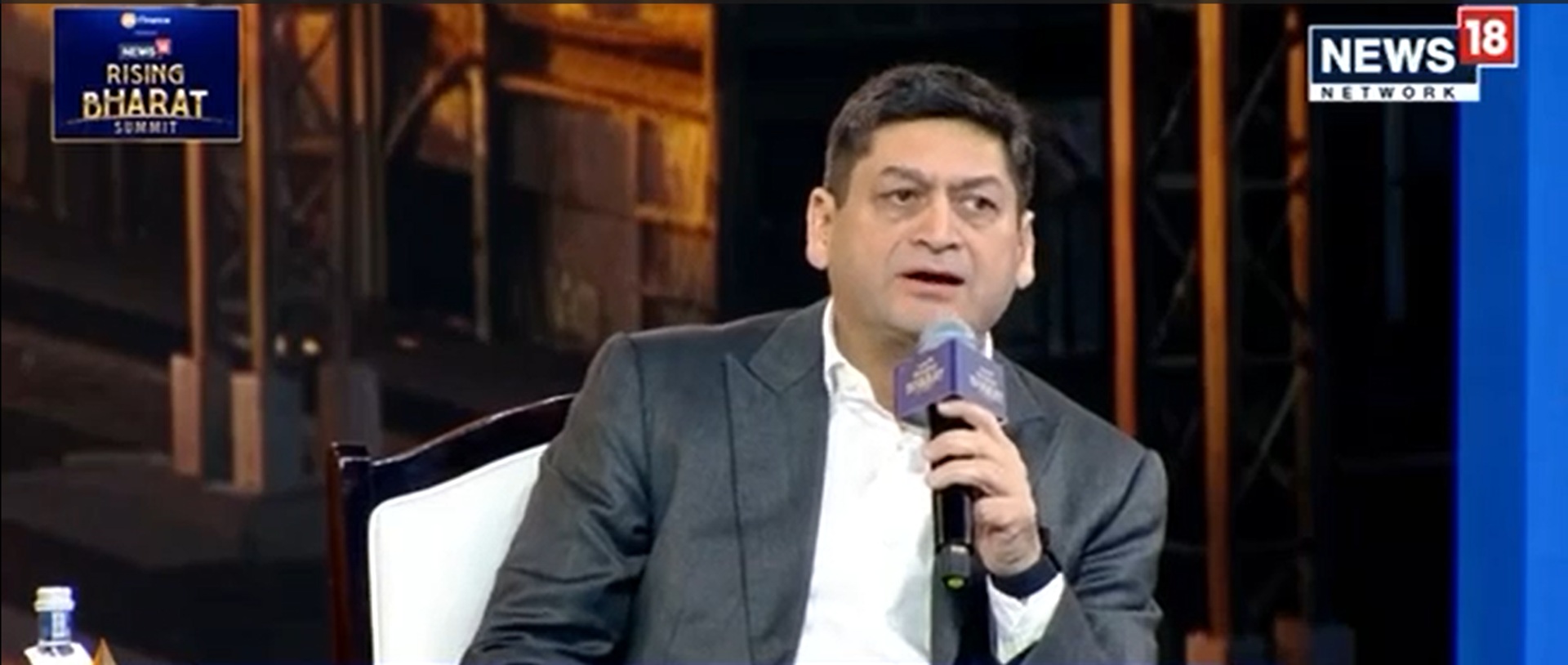
Interview Transcript
Chandra R. Srikanth: Thank you very much. Prashant, welcome to Rising Bharat Summit. Such a
pleasure to speak to you and the session on family business, but before I come to that, it’s been such
a roller coaster ride for Essar group in the last decade. You’ve had your shares of ups and downs. But
as you look at Essar today, are you happy at where you are and what are the plans going forward?
Prashant Ruia: First of all, thank you for having me here. Yeah, you can say we’ve had a fair share of
ups and downs, but that’s how a journey of 50 years or 55 years is because the group was founded in 1969. And I think most groups go through a period of ups and downs in a journey.
The good news is that we are at a stage now where, frankly, the environment which we are in right
now is extremely positive. And the things which our group has been known for, our strengths, is
what is in demand. For many years, the commodity businesses, whether it is energy or whether it
was infrastructure or whether it was metals and mining, things which we think we do it well, were a
little bit getting left behind. Those sectors were not getting invested in. Everybody felt that energy
transition is something which we adopted, but that will take over and leave behind a lot of these
other sectors. That’s completely changed. Globally, there is a huge resurrection and demand for
energy, whether it is power, whether it is oil, whether it is gas, along with the new energies, along
with renewable power and other things. So we find ourselves at a place where we can really
contribute with our strength in building assets and bringing it up to scale and making them
operational. So I think, overall, I think we are in a good place.
Chandra R. Srikanth: Great. So keeping with Rising Bharat, you see a rising Essar going forward. But
which vertical are you going to bet big on? Because you are a pretty diversified conglomerate now
from energy to metals and mining to infrastructure to technology. What are you going to invest
behind? Energy transition has been a big theme for you.
Prashant Ruia: Yeah, absolutely. So energy transition is a huge theme for us across the group. But as
we all know, last few years, last I would say one year since President Trump has actually come, there
has been a little bit of a pullback on the growth and scale of energy transition. I think there has been
a clear requirement for green technologies. But green technologies which are economically viable is
where the world is moving to, including countries like Europe and the U.S. which were really at the
forefront of these investments. So we are investing obviously in energy transition. But in the energy
space, there is a significant investment in the U.K. where we are 20% supplier of fuel for the U.K.
economy with a refinery there. And we are investing in hydrogen – I would say one of the world’s
largest hydrogen plants for the U.K. It’s 350 megawatt plant. It’s a big investment. And so that’s in
the energy side. We are also in building biofuels in India.
Chandra R. Srikanth: You have a big refinery coming up in Jamnagar, right?
Prashant Ruia: Yeah, it’s a biofuel refinery focused on making sustainable aviation fuel. And then
we’ve got oil and gas which is our traditional business in the energy space. Infrastructure is pretty
standard. We are in the power sector, port sector, and our group actually started as a construction
business. So EPC is something which we do and really one of our strengths, I would say.
And then in technology side, very interesting, a couple of companies in the U.S. which is doing
network infrastructure, Black Box. We’re actually building data centers for the likes of Google or
Microsoft or people like that and managing their networks. So it’s a really booming industry,
booming space in the U.S. right now. And we’re doing mobility, green mobility for India. And finally,
metals and mining, we’ve got a major investment in the U.S. in Minnesota. So diversified group of
companies, but all of which seem to be in the right place at the right time.
Chandra R. Srikanth: Right. What opportunities do you see in terms of data centers? Because it plays
into two of your verticals, which is infrastructure and energy. So do you see yourself playing a big role
in building out some of these data centers for technology companies?
Prashant Ruia: Absolutely. The way I would look at it, data centers really has two parts. One part is
the infrastructure. There’s a huge demand for additional power and additional infrastructure to
power these data centers. There was one estimate in the U.S. where they need 120 gigawatts of new
power just to power the AI data centers. And that’s only in the U.S. And then you add it up across all
the countries. There’s a huge growth of demand for power. We are basically picking up digital
infrastructure as a theme and we’re proposing to build a data center infrastructure in the U.K. where
we want to develop a one gigawatt data center. There the primary focus for us is to build the power,
generate the power and provide the buildings and infrastructure, and then the Microsofts or
Googles of the world will come in and make the investment in the computers and the chips. Then
we’re doing something similar here, we’ve also signed for a data center in Mumbai and in Delhi. So
it’s certainly a space of growth for us.
Chandra R. Srikanth: Right. Prashant, I should ask you, geopolitics has been such a dominant topic in
the last year. As a business leader running a company or a group with operations around the world,
split between U.K., India and other markets, has your blood pressure been okay? Looking at all the
discussions around, you know, trade deals and what the relationships between countries, when they
patch up, when they break up.
Prashant Ruia: Well, there’s certainly been a lot of uncertainty. I don’t think it’s affected our blood
pressure that much, but uncertainty has been there. But I think, you know, if you think about what
the West is doing increasingly is basically, something which, frankly, India has done for a long time or
in the emerging markets, people have done for a long time – which is imposing an import tariff. I
mean, it’s something which we are not used to because they’ve never done it for the last 40, 50
years. But it’s not a concept which is alien to us in India. The fact of the matter is that the cost of
manufacturing in the developed world is much more than the cost of manufacturing in the emerging
world, including India. And ultimately, I think they’ve realized that manufacturing locally needs to be
provided with some level of protection to not actually protect, but to ensure that the local
manufacturing is more competitive. So that’s the concept with which they are trying this. Obviously,
Europe is not there yet, but the debate is there very much after what’s happening in America. There
is a debate around what is the best way to ensure that you continue to have a manufacturing base in
these countries.
Chandra R. Srikanth: Right. Since the theme was on family businesses, I should ask you, there is this, I
won’t say belief, but there is a statistic that by the time you reach the third generation, that’s when
things start to get tricky. Now, your father and his brother started up Essar. You took it forward. I
remember you started on the shop floor at 15. Is it hard to get your kids to be part of the group?
Because a lot of Gen Z or Gen Alpha, next gen kids like to run family offices these days.
Prashant Ruia: It’s a very good question. At least for us at Essar and our family, we’ve been very
fortunate that we’re still a joint family. My father, my uncle built the whole business. And our second
generation, I am along with my brother and my uncle’s children, Smiti and Rewant and Anshuman.
So we’ve been really together forever, really. I think the third gen is just getting in now.
Chandra R. Srikanth: Have you inducted them into the Marwadi School of Management?
Prashant Ruia: My father tried to put them through Marwadi School of Management – it didn’t work.
They all went overseas, did their education overseas. But they’ve come back and now some of them
are part of the business, some of them are doing things on their own. But I think the requirement to
keep them engaged, is a real key point. You need to get them engaged and liking what they are
doing. Because if they are not excited about what they are doing, it’s very difficult to get them
involved in the family business. It doesn’t matter which business it is. And then to get them engaged,
I think having a little bit more of the newer technologies or, cutting edge, sustainability, energy
transition – these are the kind of things which still excite them. So I think if you want the next gen to
be in business, it has to be interesting for them enough to get involved. Once they get involved, then
I think it’s fair game. I don’t believe that everybody wants to be family office. Many do, I’m not
saying no. But I think there’s also a case to be made that you can get them involved in the business,
and then once they are involved, then it’s on. There are many examples of that, too, along with the
family, family office examples. So let’s see, time will tell. Our third gen is just getting involved. They
just started working in the last couple of years. Till now, things are going well. But I don’t know. We’ll
see what happens in the future.
Chandra R. Srikanth: There’s also been instances where there’s been very bitter fights in family
owned businesses. Again, have you come up with a formula to navigate that?
Prashant Ruia: That’s very individual. I think the primary thing about family business is still 70% of
businesses globally are still managed by families. People generally get a feeling that family business
are going down and the MNCs and professionals growing up. I’m not saying that’s not happening,
but still 70%, including in the U.S., is still family run. So I think this tradition is going to continue.
Entrepreneurship, which is having a little bit more of a longer term view, I think is still going to stay
very much with the families. They bring that to the table. And if we can marry the entrepreneurship
along with creating the right governance for business, I think it’s a deadly combination. If you can get
both going, then it’s a perfect mix. You get the strengths of entrepreneurship and yet you get the
strengths of professional, all the governance, all of that. So that’s at least what we’re trying to do. I
think generally, the younger generations are less tolerant. Want me to say that? But that’s what you
have to inculcate or that’s the culture which you have to bring up in the children. So I would not
want to get into individual issues, but I think it’s still a tradition which can be held and which can be
a tremendous strength for any country.
Chandra R. Srikanth: Great. On that note, thank you very much, Prashant. It’s been an amazing
conversation. A huge round of applause for Prashant Ruia, of Essar Group.








 User
User