
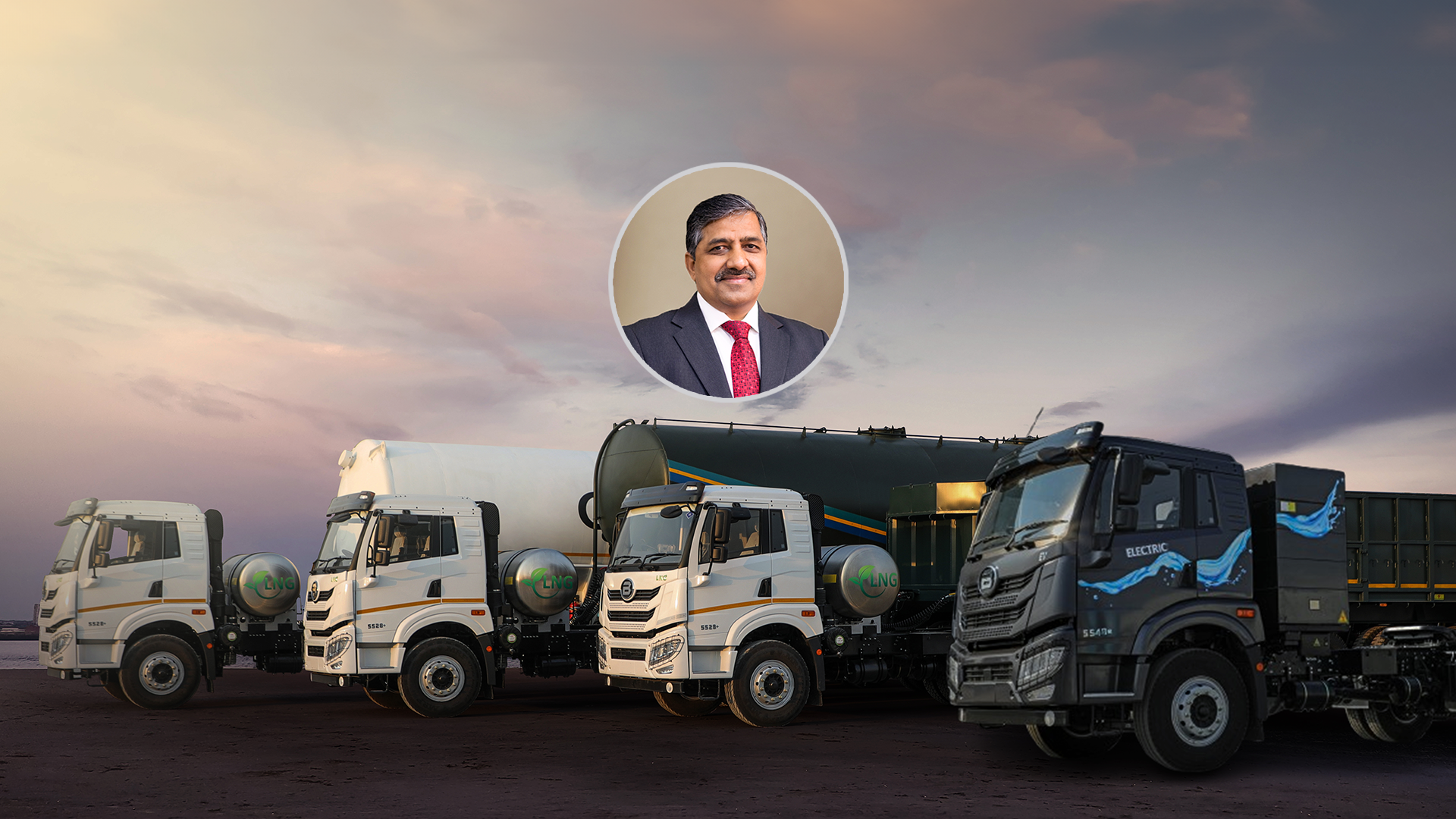
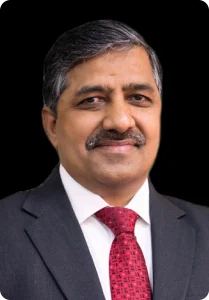
B. C. Tripathi, Operating Partner – Energy at Essar Group, offers his insights on India’s evolving energy landscape in his article published in Business India.
India charts a credible pathway of how growth and decarbonisation can advance together, shaping the future energy landscape
Today, India stands at the intersection of two critical national priorities: sustaining a fast economic trajectory while undertaking a large and complex energy transition programme. This is not just a choice between growth and decarbonisation. It is a strategic task to integrate traditional and new energy systems. We have the opportunity to demonstrate a pragmatic, scalable and responsible transition model that reconciles our legitimate “right to grow” as a developing economy with climate action.
The year 2025 was a record-breaking year for India’s clean energy and emissions. As stated by the Minister of New and Renewable Energy last week India’s non-fossil fuel installed capacity increased to 267 gigawatts, a 23% increase over 2024 i.e., 49 GW of additional capacity during last year. Solar power led the expansion, with installed capacity increasing to 136 GW in 2025 from 98 GW in 2024, growing by 39%. Wind energy capacity rose by 13% to 55 GW. Solar and wind drove India’s renewable energy expansion during the year.
India has now entered its critical phase in energy transition, where it is pushing to align expanding economy with cleaner fuels for energy needs. Early signals are very encouraging. India is poised to become the world’s second largest solar market this year with solar capacity additions reaching over 50 gigawatts, overtaking the United States, according to forecasts from BloombergNEF. In that process, it will also become the world’s fastest growing major market for solar installations—India’s solar additions may grow at 6% compared to a degrowth of 14% in the US and China. Make no mistake, China will still add 321 gigawatts of solar capacity in 2026, but if India maintains its current pace, it is on track to achieve its 2030 target of 500 GW of non-fossil fuel capacity.
The momentum is in favour of renewables-fired liquid fuels. Last week, Germany’s Uniper Global Commodities and AM Green Ammonia signed a long-term binding offtake agreement for 500,000 tons per year of renewable ammonia, with first shipment expected in 2028, a step forward in Prime Minister Narendra Modi’s green hydrogen mission to become a global hub for production and exports of green hydrogen and green ammonia.
It does not stop there. Research from Council on Energy, Environment and Water (CEEW), found that circularity in seven sectors alone offers an Rs11.5 trillion ($132 billion) annual market by 2047, that has potential to create 8.4 million full-time equivalent jobs and attract Rs10.8 trillion in investments.
However, challenge remains formidable. India, now world’s third largest emitter in absolute terms, needs an economic growth over 8% annually to achieve the Prime Minister’s goal of Viksit Bharat by 2047, while also progressing towards a Net Zero target by 2070. It’s not about slowing growth, but to change its carbon intensity.
A careful balancing of ambition and realism is needed at such inflexion point. Energy demand in India is on the rise, driven by sustained GDP growth and new avenues of electricity consumption like data centres and AI. UN Climate Body’s Paris Agreement, which aims to cap a rise in global temperature levels at 1.5-2 degree centigrade over pre-industrial levels, constraints the available carbon space for developing economies, even as their developmental needs remain pressing. India’s pathway must be of “responsible transition” – pushing renewables and low-carbon technologies while deploying cleaner fossil fuels and transitional solutions to ensure affordability and energy security.
India plans to add 80 GW of critical, less polluting coal-fired generators in the next seven years, based on domestically available coal. Refining capacity is being enhanced to meet rising demand of transport fuels and petrochemicals, which is growing at 3-4%; demand for chemicals is aligned to ~7% economic growth. Carbon capture utilisation and storage will also play a major role to sequester carbon emitted from power generators and industries, subject to cost and scalability.
Natural gas will be the central pillar in India’s energy transition, just the way it plays a major role in the US and Europe-from being a substitute to diesel and gasoline in cars and trucks to emerge as a flexible baseload and balance for intermittent renewables. The Indian governments’ objective to increase the share of natural gas to 15% in the energy mix, indicates the importance as a cleaner bridge fuel.
While India’s cumulative emissions remain low, and expected to grow by 1.4% in 2025, its slower that USA’s 1.9% but faster than China’s 0.4%. This signals that India is on-track, decoupling of growth from emissions intensity.
The philosophy of “Responsible Integrated Transition’’ is the path that Essar group is pursuing, with diversified global energy and commodity value chain spanning natural gas, LNG, refining, green mobility, cleaner power and green hydrogen, operating under an integrated framework.
EOGEPL today contributes nearly half of India’s fast-growing production of coal bed methane, producing 1 million cubic metres a day, with plans to increase unconventional gas share from ~1% to ~5% of India’s total gas production of around 100 MMSCMD, supporting expansion of India’s gas-based economy.
The Stanlow refinery in UK is one of Europe’s most advanced refineries, supplies around 16% of the country’s road fuels, and is targeting a 95% reduction in emissions. EET Hydrogen Power is building Europe’s first hydrogen-ready combined heat & power plant at Stanlow to supply low-carbon power and steam under a $3 billion investment program.
Essar Ports plans to expand capacity across India, UK and Indonesia to over 200 million tons a year, including a 50 million tonne expansion at Salaya with infrastructure for LNG, biofuels and containers. A proposed bio-refinery at Salaya will produce sustainable aviation fuel and next-gen fuels such as e-methanol & green ammonia, supporting decarbonisation of hard-to-abate sectors. Essar Power is developing 10 GW of clean power generation capacity.
In mobility, Essar’s green mobility ecosystem is decarbonising heavy freight via a mix of LNG and electric trucks supported by retail and fuelling infrastructure. It aims to scale to 30,000 LNG and EV trucks and 100 retail outlets, abating one million tonnes of CO₂ annually.
Financing will be the most critical lever for this transition. As UN Climate Change Executive Secretary Simon Stiell has noted, $2 trillion has been invested into clean energy and infrastructure last year, twice as much as in fossil fuels. The world got from nearly nothing to $2 trillion in little more than a decade. India needs annual investments of $350-$400 billion in its clean energy businesses, as indicated by various estimates. Yet, commitment of $1.3 trillion per year in annual climate financing remain unmet from the Global North.
Essar, after concluding its planned asset monetization programme, has repaid $25 billion (₹2,00,000 crore) of debt, deleveraging its balance sheet. With this strengthened financial position, the financing approach combines prudent debt, equity deployment, internal accruals, and investor capital, ensuring stability in the legacy businesses while enabling long-term investments in future growth and energy transition.
The Indian government must create structural reforms to enable big investments in low carbon energy and then deploy in a cost-effective way. Long term offtake frameworks for green hydrogen, ammonia & SAF etc. are crucial for development of low carbon fuels, while buildout of battery storage and transmission infrastructure will make renewable energy deployable and reliable.
We expect the upcoming Union Budget to accelerate India’s clean mobility and energy transition by enabling affordable financing for LNG and EV trucks, supporting domestic manufacturing through targeted incentives, and introducing performance-linked regulatory measures. These initiatives would reduce fuel imports, lower emissions, and improve logistics efficiency, creating scalable opportunities for capital deployment and sustainable growth.
India is the largest and most credible opportunity for long-term, responsible capital deployment. Essar has positioned itself as an integrated platform capable of absorbing large-scale global capital and deploy it across the full energy transition value chain – from molecules to electrons, from ports to power, from mobility to manufacturing.
India’s energy transition is one of the defining transformations of our century. It’s not about choosing the old or the new, but about intelligent integration of both. Combining scale, policy transformation, industrial capability, and capital mobilisation, India can chart a credible pathway of how growth and decarbonisation can advance together.
In this journey, Essar Group with its global footprint, can play a pivotal role as a responsible builder of India’s low-carbon future.
Source: Business India (January 19 – February 1, 2026 )

































 User
User