
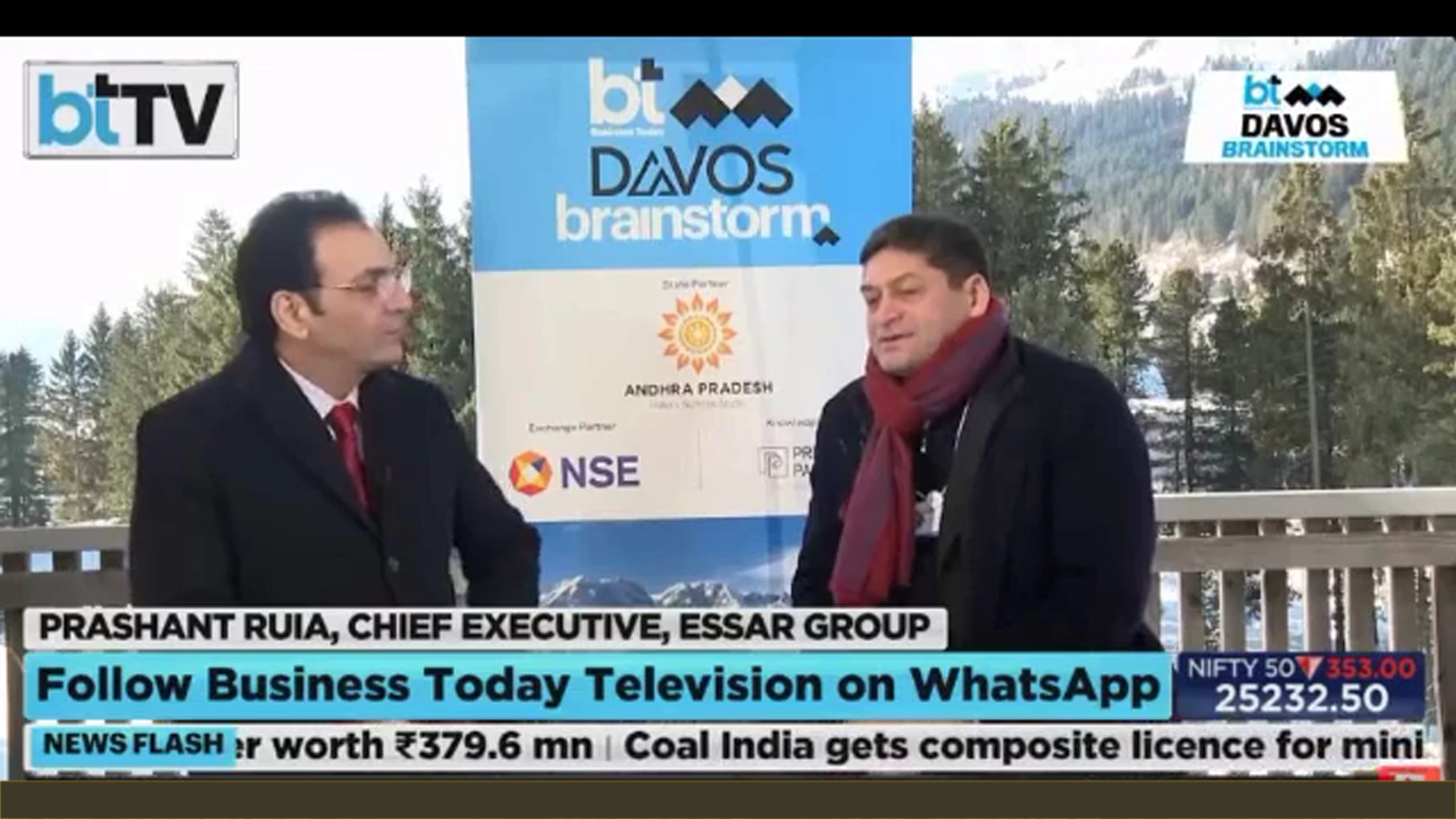
A candid discussion on global trade disruption, manufacturing, energy transition, grounded in economic viability, the need for stronger R&D, why India remains a compelling investment destination, and Essar’s growth strategy across its core sectors.
Audio
Interview Transcript
Siddharth Zarabi– Hello and welcome from the World Economic Forum here at Davos. I am Siddharth Zarabi and with us on our continuing coverage is Prashant Ruia, CEO of the Essar group. Prashant, welcome to the 2026 brainstorm as we are calling it. It’s clearly a time when the global trade disruption is top of mind of all CEOs. The second one is of course AI. And all that is happening in terms of the geopolitical uncertainty. But for Indian companies, it’s also a time of opportunity as your group also demonstrates. Tell us about your own understanding of the trade-related disruption and what are the challenges and opportunities that it provides.
Prashant Ruia– Thank you, first of all, Siddharth, for having me and I think, I’ve been doing this for a few years with you and it’s a great occasion and I always enjoy being at Davos. But I think this time is, it’s all about the trade and the trade disruption and the risks which are coming around with the divergence in trade policies of the various countries. For a very long time, the world was moving towards a central global trade where markets would remain open and people could trade freely between countries. And the whole world was, the WTO and all of the world was pushing towards that paradigm or that world order. I think that has now completely got disrupted and every country is moving much more into bilateral arrangements, which is why we are seeing so many of the free trade agreements or the trade agreements. And obviously, America is playing a very major role in reshaping the whole trade order. And I think one of the other reasons it’s developing this way is because people had begun, especially in the West, people had started to lose a lot of jobs, especially, and they started to lose their manufacturing base. And then I think there is a realization that that is not something which they can afford to completely lose. And therefore, the need to maintain manufacturing, maintain the jobs within the country at the cost of just importing everything from the cheapest source. So, I think that’s the dichotomy taking place in the West.
They want to retain manufacturing, they want to retain their jobs, but at the same time, they want to have an open border policy. And the two- they can’t go together because principally, cost of manufacturing in Europe or the US is more than the cost of manufacturing in India or China or the Middle East for that matter. And so principally, if you want to retain your manufacturing base, you have to provide some level of protection, whether that’s in the form of import duty or trade barrier, or there are many ways to do it. But at the end of the day, if they have to retain manufacturing, in certain, in many sectors where it’s cheaper to do elsewhere, then there will have to be some level of protection in one form or the other.
Siddharth Zarabi– Do you see them succeeding? And if so, to what extent?
Prashant Ruia– I mean, we are big investors in the US, we are big investors in the UK. It’s a huge battle internally.
But I think the choice is clear. If they want to retain their manufacturing base, then they will have to, provide a certain level of- I won’t say protection, but certain compensation one way or the other against cheaper imports. And, ultimately, I think the battle for keeping manufacturing within the country will win.
Siddharth Zarabi– Prashant, yourself and your business, you’ve been in oil, in steel. So, you understand the commodity complex very well. That’s also part, one of the undertones and India, in particular for our Russian oil imports, there’s a tariff that we have taken. But broadly speaking, when it comes to the energy space, there are several signals that emanate, particularly from the United States, a belief that climate related goals should not drive energy policy. Nuclear is being spoken about in other parts of the world and how mistakes were made, particularly, for example, in Germany, in Europe. And then what the US is doing. The energy mix that you see evolving as of now, what is that going to be?
Prashant Ruia– So, look, I think for a few years, and including in Davos, whole energy transition was the big thing. You know, how we can bring green energy, whether it’s green hydrogen, whether it’s renewable power, whether it’s all of these things, to replace fossil fuels. And I think that was the huge theme for the last, I would say, five, ten years.
And there was a belief, somehow, and we being in the industry, knew that wasn’t true. But there was a belief, when you spoke to people outside, that you flip a switch and you can shut down all your old power plants and shut down all your old refineries and shut down all your old steel plants and you can now replace them with all green new facilities. Being from the industry, if you spoke to anybody in the industry, he would say this is not going to happen. It’s not possible. But that was the popular belief. And I think now, in the last two years, and President Trump has sort of called it, and that is that it is not something which you can replace. I think fossil fuels are going to be there for a long period of time. But it is possible to do green energy, especially renewable power.
India is a great example of what we are doing in renewable power. China is a great example of what we are doing. But it is possible, I think, we think, it is possible where it is economically viable. So, if it is economically viable, and then you can replace fossil fuels with green, I think that’s the best combination. And wherever the technology gets to the place where it becomes economically viable, then I think it’s going to take off. I mean, we have a great example in India. We recently launched electric trucks and LNG trucks in India. And they are based on electricity which is renewable power. And we are offering that as a service without any subsidy. There is no subsidy involved. So, if you go to a customer and say, we are going to replace your diesel truck with an electric truck, and you don’t have to pay more for it.
Siddharth Zarabi– We’ll probably take it.
Prashant Ruia– Then, no, every one of them will take it. There is no probably. Every one of them will take it. Because they want to do good for the environment. But they don’t want to pay more. So, I think that’s the debate. And, and I think President Trump is saying- he’s pushed the agenda to say, you don’t just think for green, for the sake of green. If it’s, I think, if there’s no big government subsidy involved, or if there’s no, policy involved, then it’s doomed. That’s where we’re going.
Siddharth Zarabi– Prashant, one of the things, and you’ve been working on this for years now, is also about technology, the supply chain. And we’ve seen recent examples without naming any of even technology denial, because control and dominance is with China in many spheres. There are US companies as well, and Indian companies have found it a bit hard, I would say. What’s your own sense? What is holding back a full-scale sort of productivity enhancement in this space?
Prashant Ruia– Well, I think the larger issue, Siddharth, honestly, the larger issue for India is, how can we become more of an R&D economy?
Siddharth Zarabi– So, you’re saying domestic innovation?
Prashant Ruia– As a nation, I think that’s one of the things which we are not good at. And we don’t invest enough. And all companies, including ours are happy buying the technology, the best technology from whoever has it, and then building capacity here, or anywhere else in the world. I think that’s the big difference. So, whether you talk about China, or you talk about the US, innovation and R&D is a huge, is a huge part of their economy. And I think they’re winning because of that. And while we have done great in building a supply chain, as an alternate supply chain, for the Western world or for other parts of the country. And I think we’re doing a fantastic job in that space. I think unless we can have our own technology, and our own R&D this will always be a challenge. Because you will always be dependent on getting technology from someone or the other.
Siddharth Zarabi– For years, whenever I’ve covered the union budget, one number that is looked at is the R&D you know, sort of budgetary allocation across ministries. But that’s the government’s part, you touched upon what private sector is doing, I would say in defense of Indian industry, that post reforms, there was also a need to get things going. And perhaps that was the lead motive at that time. Going forward now, what is it? Is it a question of government support? Is it about schemes and incentives? Or is it just a big industrialist saying, okay, we are going to, you got five years, we won’t see a return. But we will do it. What is it?
Prashant Ruia– I think it’s all of it. So just like India went about building up a startup economy. If you think about how Prime Minister Modi introduced that whole concept. And if you think about how in the last 10 years, in the last decade, India has gone from virtually not being big in startups to becoming one of the largest startup economies globally, it’s the same kind of mission, which we need for R&D. And the government has to play its part, the private sector has to play its part, grants have to have to play its part. It’s a full economy. And you’re right, the returns on that will come over a period of time. But they will come. I mean, in the space area, if you think about it, what India is doing on the space side. It’s because of the R&D and because of the innovation which India is bringing, which is why we are able to put the rockets up at such a low cost. So, we know it’s doable. I mean, I believe our costs are a fifth or maybe even lower than the American or the other parts of the world. So, it’s doable. And I think that’s, we’ve got to create an economy for R&D. And everybody has to play a part.
Siddharth Zarabi– Absolutely. In fact, a lot of that is also happening in certain new age sectors. I want to turn back to three years ago, right here, when you outlined the group’s plans, including sharing with our viewers at that stage, the massive debt reduction that you had done and the cleanup. Some time has passed. I want you to look ahead now. What are the new initiatives that you are pursuing, basis what you have achieved in the past three to five years?
Prashant Ruia– First of all, entire focus is looking ahead. So, we are, in the last few years, we have organized our group to identify various opportunities to invest in. We remain focused on the four sectors which we have been involved with for the last two, three decades, whether it’s the energy, metals and mining, infrastructure and technology. So, those sectors remain the same. We believe we have decent knowledge in those sectors which we’ve gathered over the last two, three decades. And what’s more? Suddenly, the world is looking for manufacturing, the world is looking for energy, the world is looking for power. So, all these sectors are, once again, people are investing in droves, whether it is power for data centers, whether it is renewable power for power, whether it is batteries for power. So, all of these sectors which we have infrastructure- increase the infrastructure capacity in India. I mean, India is a prime example of the infrastructure investment taking place, largely led by the government. But the quality of the infrastructure coming up is just amazing. I mean, honestly, every new infrastructure investment we see its world class. So, we are remaining focused in these sectors.
We believe it’s a great time to be investing here. And our philosophy remains the same. We are investing across the world. So, we have large investments in the US, UK, India and other parts of the world. Obviously, India remains the base, India remains our headquarters, India remains our primary, area of focus. And within that, so, it’s, in the energy space, it’s obviously downstream refining, it’s retail, it’s building an oil and gas company. We are investing in biofuels, in building a sustainable aviation fuel plant. And then infrastructure, it’s the same sectors- It’s ports, it’s power. And we have an EPC business. So, we’re developing that. And then in the US, one of our companies we are investing is Masabi, which is in Minnesota, where we have a large iron ore mine. And we are building a pellet plant for green steel or for DRI steel. So, that’s a fairly substantial investment, probably one of India’s largest investments in the US, nearly $2.5 billion investment. And then technology-so we have a company doing network infrastructure, building data centers. We are also looking at investing in data centers. Because we see that more as an infrastructure play for data centers, power, land, buildings. And so we’re looking at that very seriously. And the trucks, which we mentioned. So, it’s within the same sectors. But we think that there is opportunity to grow in almost all of them.
Siddharth Zarabi– How large is the data center opportunity? Because over the recent past, there have been some headline announcements, including in the state of Andhra Pradesh, by Google, and a few others. How large is that opportunity?
Prashant Ruia– Well, we are trying to build a data center or rather develop data centers of two gigawatts, up to two gigawatts for now. That itself is large. Because we are also looking at providing the power for that. So, it’s not just building the buildings, it’s all of that. But that opportunity is massive. I mean, I can give you a bigger number here and it’ll be well, it’s still doable. But so, we are developing one gigawatt in UK. And then we are developing a gigawatt here in India.
Siddharth Zarabi– The four tentpoles or four pillars of your group’s operations, if you were to try and divide it between the domestic revenue base and how much of it can eventually come from overseas, how much will it be? And is there an overseas expansion possible further in the oil and gas space that you know very well, primarily because of the account of a change policy approach?
Prashant Ruia– Well, we are looking at, from our parent company, we look at every of these, we have about 10 portfolio companies which we invest in. And most of them are closely held right now. We don’t have too many companies other than Black Box, which is on the public markets. And we look at each opportunity depending on what, those investments proceed. But broadly, I would say India would certainly be 50% or more of the group in whichever way we do it. We still are primarily focused on developing in India. We do believe that the Indian story is very strong for the next few years. And private sector investment in the space which we are in has not been that much in the last few years. And therefore, that gives us an opportunity to participate in that. And then we go from there depending on the countries which have opportunity and not in the sectors which we have
Siddharth Zarabi– Are there any headwinds to the India growth story that you just spoke about that you see at a macro level that you want to highlight and perhaps also seek some sort of resolution to?
Prashant Ruia– Well, I have thought about this many time and I am not able to come up with too many headwinds at all. Because, demographics are in our favor. The fiscal position of the country is a tremendous position, much better than most. Entrepreneurship in India is extremely high. Government policies are extremely stable. So, we have got all the ingredients to do it. If we don’t, in this environment, if you can’t do it and succeed, I mean, I don’t think you have anybody else to blame but yourself. Because that’s the opportunity which is there. I mean, if something really goes very wrong in terms of our international trade with the U.S. or something like that, could be. But even then, I don’t think we are that big a large, we are not a big export economy for America, certainly not. And so, I mean, no, I think it’s a great time. I honestly feel it’s a great time to be in India and to invest in India.
Siddharth Zarabi– If a trade deal with the U.S. were not to materialize, what will happen?
Prashant Ruia– Specifically in our business, it doesn’t affect us in the sector which we are. I mean, there are a couple of sectors which we all know which are doing some exports to the U.S. They will find new markets.
Siddharth Zarabi– They will find new markets.
Prashant Ruia– And there are many markets.
Siddharth Zarabi– And perhaps, add a free trade agreement and drive the push including the European Union, which is likely. Okay, as we wind down the conversation, I also want you to dwell upon 2025, look back, but for 2026, a year of reforms, massive taxation reforms, labor code, allowing the private sector into nuclear power, for example, and a very long list. What remains to be done in 2026?
Prashant Ruia– I think government from a tax perspective, from a GST perspective- when we are looking at opportunity now, we are really not looking at opportunities where we see significant policy change is required to make it happen. In the past, when we would look at investments, we would think- we need this to be modified or we need this to be changed to make it better. We don’t come across much of that right now. Will there be something in some industry on the side? I am sure there will be. There is always room to improve. I am not saying that. But if you look at the big building blocks, I think we have them in place and we can invest and we can grow as private capital. All the sectors are open. There is no restriction really. The biggest sector which was restricted to some extent was insurance and all of these, have also been opened up. Private, international capital is coming into banking. Again, something which never happened before.
Siddharth Zarabi– We have seen Japanese pick up.
Prashant Ruia– Japanese pick up. Reserve Bank has opened up. They have allowed that to happen.
Siddharth Zarabi– Capital market regulation is changing and being made more amenable.
Prashant Ruia– And it’s a very deep capital market. So, I know what you are asking me is to find something to change. But I am not able to, to be honest.
Siddharth Zarabi– You said deep capital market. Have you been looking at it for for any of your portfolio companies?
Prashant Ruia– We will, we have to. I mean, we are currently not a very big player in the capital markets. But obviously that can’t be forever.
Siddharth Zarabi– Okay. And that will bring us to another conversation at another time, Prashant Ruia. Thank you very much for your time with us today. With that, it’s a wrap. We will see you again. Until then, goodbye.

















 User
User