
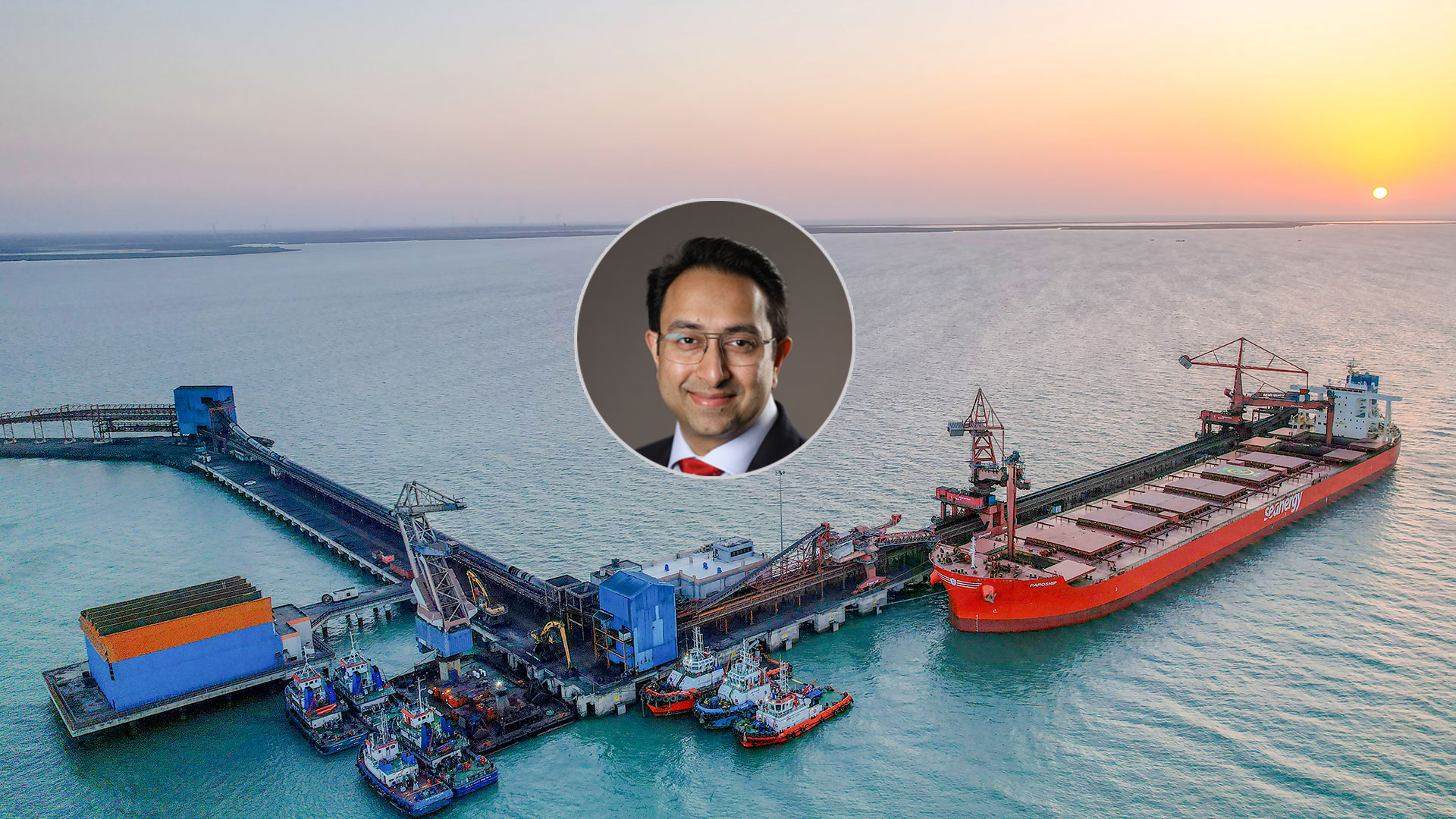
This time, Essar Ports is shifting from a captive-only model to a commercial play, while evaluating land-side infrastructure to build a logistics platform.
The Essar Group, once India’s second-largest private port operator by capacity, is seeking to build back its port business after selling a huge chunk of its assets to Rosneft (Nayara Energy) and ArcelorMittal Nippon Steel (AMNS) a few years ago, the head of its port unit said in an interview.
“We had a good foundation in the port sector, which we had to part with because of the strategic call by management to deleverage the group. It was the need of the hour as part of the larger objective,” Ashish Rajgarhia, Executive Director, Essar Ports Ltd, told ET Infra.
“We have deleveraged and we are completely debt-free today. We want to build back. We understand the sector; there is so much room for growth given the limited number of players … the scope is just humungous,” Rajgarhia stated.
“Port is going to become a sunrise sector as far as India is concerned. India has some 2.7-2.8 billion tonnes of port capacity today and under the Viksit Bharat plan, it will go up to 10 billion tonnes by 2047. China, which has a similar population, today has an operational port capacity of 18 billion tonnes. Our container throughput today is some 24 million TEUs, they are at 300 million TEUs. So, there is so much head room as far as the sector is concerned. Secondly, if you see the number of players, there are 12 major ports owned by the Central government, and then there are only a couple of large private port operators leading to a big vacuum in the sector,” he continued.
“We have basically set a vision that if India will have 10 billion tonnes port capacity by 2047, we should be 5 per cent of that, say 400-500 mt of capacity,” he asserted, adding that it will pursue a “mix of organic and inorganic opportunities” to achieve the goal.
Deleveraging forced a strategic reset
Till a few years ago, Essar Ports had a cargo handling capacity of 228 million tonnes (mt).
“We monetised about 168 mt capacity to Rosneft (Nayara Energy) and AMNS. Those assets were integral to the respective industrial units. We were captive port operators; that was how we were structured earlier and when we sold the steel plant, we also sold our facilities in Vizag, Paradip and Hazira ports with it and when we sold the refinery, we also sold the Vadinar oil terminal with it. That’s how we had to give away 168 mt of capacity,” Rajgarhia said.
Currently, Essar Ports runs 60 mt of capacity across three operational facilities and has a concession at Mozambique port to build a 20 mt coal berth.
Rajgarhia emphasised that Essar Group’s port unit is debt-free.
“We have no debt in ports. Today, we are doing an EBITDA of $175 million from 60 mt of operational capacity and have zero debt. All the three ports/terminals have zero debt. So, I can leverage my current asset base for growth. I have a foundation; I am in India and overseas,” Rajgharia explained.
Rethinking the port model
In its bid to build back the port business, Essar Ports is changing its strategic course this time round.
“We were always the second largest private port operator in India that too just on a captive model. We have let go our position. This time round, we are not locking ourselves in a captive box. That is a big change. We are now looking at it more as a commercial play and not as a captive business. We want to expand, we know the sector well and we have built these assets ourselves. Many port operators have grown through organic and inorganic route. In our case, we have built these port assets ourselves, operated them and then also monetised them at very rich valuations largely because of the quality of assets. So, we are very clear and sure that the time is ripe for us to grow back,” he noted.
Of the three operational ports/terminals it runs, only one is in India, located at Salaya near Jamnagar in Gujarat, which supports a power plant run by the Group from a 20 mt coal berth.
“It’s a captive berth feeding the power plant, but we have the optionality to handle commercial cargo also equivalent to captive cargo. It’s an approval that we have as part of the captive berth; whatever is the captive load, equivalent quantity we can do commercial also. It’s a natural deep draft port, we are 5.5 kms into the sea, we don’t have to do any maintenance dredging, it’s a state-of-the-art port with a 14 km-long conveyor going directly to the power plant,” Rajgharia continued.
Though the 30-year concession period granted by the Gujarat Maritime Board for the Salaya port ends in 2038, it is expected to be extended.
“It is a captive concession linked to the life of the power plant. So, we only have to go for a roll over or an extension in 2038. The power plant is fairly new, and it has a life of 50 years plus,” he said.
Essar Ports plans to convert Salaya into a commercial port. “The current berth cannot be converted into a commercial berth, but we eventually want to have a commercial port in Gujarat,” he stated.
Salaya port is being connected to the Indian Railways network via a 16.5 km railway line under the PM Gati Shakti scheme (of which 14.5 km is ready), at an investment of about ₹200 crore.
The company runs a 20 mt capacity port in the UK – a 3 million cubic metres tankage capacity (equivalent to 20 mt), that supports the refinery at Stanlow. The capacity utilisation of the state-of-the-art facility is about 70 per cent. “There is a room to do a commercial of 30 per cent, which we are now focused on,” he says.
It also operates a 20 mt coal terminal at Melak in Indonesia’s East Kalimantan, which supports its coal mine there.
“There we have built a 75 km long road for bringing coal from the mine to the port. Now, along the 75 km-long route, there are several other mines which are smaller in capacity, but they don’t have the financial wherewithal to invest in the road, and the road leads to our port. So, eventually, they will all have to come to us if they want to ship out the coal, which either we will buy them out or they will give us a cargo handling contract. So, either way, our business model is we want to handle the coal at our port,” Rajgharia stated.
Hence, all three operational ports, in some manner, support an industrial unit linked to the port.
Essar Ports will consider participating in major and non-major port projects to augment capacity, including current tenders at the Syama Prasad Mookerjee Port Authority, Kolkata, and Paradip Port, the upcoming major port at Vadhvan, and ports being developed by the Andhra Pradesh government.
It is one of the participants for a dry bulk cargo terminal project at Tuna-Tekra in Deendayal Port (formerly Kandla Port).
The company’s growth plans will cover ports in India and overseas.
“If we say 400-500 mt by 2047, then Mozambique is also a part of it. In Indonesia, we are investing in several mines, so our capacity will grow there also. In UK, we are expanding our refinery, putting up a hydrogen plant, so that requires more port capacity. We are also looking at a possible inorganic opportunity overseas, that’s a large tankage facility capacity, which will be roughly about 25-30 mt. It’s a growth strategy. We are exploring many things. We are not saying we will have 400-500 mt capacity in India alone. If you see my 60 mt today, 40 mt is overseas – 20 mt in Indonesia and 20 mt in UK – and only 20 mt is in India,” he says.
Being a dry bulk cargo handling port operator, Essar Ports could face some hurdles in entering the container terminal operating business. But Rajgharia does not see this as a problem.
“We have to tie up with a container terminal operator and there are several options. So, we will look at a tie-up. We don’t see that as an issue. India today is transhipping 75 per cent of its container cargo between Singapore, Colombo and Jebel Ali. So, the opportunity is huge if we have our own deep draft port. And the advantage with us is again we are on the west coast in Gujarat and the entire market of North India, including Madhya Pradesh, Rajasthan, Uttar Pradesh, Delhi, everything is being fed through west coast ports,” he said.
Expanding beyond ports
Getting into land-side infrastructure will be yet another strategic shift it is aiming for.
“We are now looking at it very actively. In fact, there is an opportunity available in Dadri, Noida for setting up a Multi Modal Logistics Hub, which is like a dry port. I think in today’s day and age, you cannot just be a port operator, you have to be a logistics player. We are also looking at it from that perspective. We don’t only want to be a port operator, we are looking at ourselves as a logistics player, with interests in ports, inland container depots and multi modal logistics parks/hubs,” he disclosed.
Source: ETInfra















 User
User